_edited.jpg)
5 Things Kids Learn From Musical Theatre Besides Acting

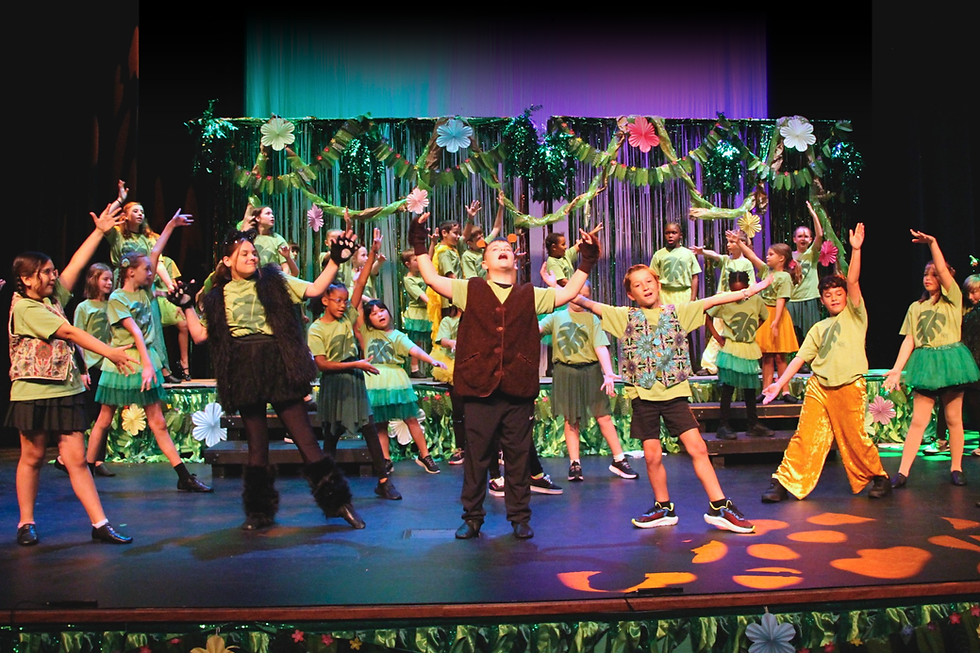
When you think about musical theatre, you might picture the obvious things: singing, dancing, memorizing lines, learning choreography, some great costumes, and performing onstage.

And yes—we spend a lot of rehearsal and class time helping our actors learn their roles for the big show.
But as someone who grew up doing theatre and has helped hundreds of young performers rehearse and perform, I know that some of the most important things kids learn from being part of a production have very little to do with what happens under the spotlight.
As a theatre director and instructor, I get to watch students walk into their first rehearsal one way and walk out of a production with skills that aren't always visible from the audience—but that they'll carry with them long after the final curtain.
At Brazos River Youth Theatre, we believe musical theatre is one of the best ways for young people in the Bryan–College Station community, Brazos Valley, and beyond to develop both as performers and as people.
Here are five of the biggest life skills I see kids learn from being in a musical:

1. Teamwork: You Can't Do a Musical Alone
One of the first things our actors discover is that theatre is a team sport.
You can be an incredibly talented singer or actor, but a musical doesn't work if everyone is only focused on themselves.
Some of my favorite moments backstage aren’t seeing an actor nail their lines or rock their solo (though, we’re always cheering them on). It's watching an older student quietly help a younger actor find their place backstage without being asked - or an actor offering to help another tie the bow on their costume.
From the first rehearsal, students learn that they have to listen to one another, share the stage, make space for other performers, and support the people around them.
Sometimes that means helping a castmate remember choreography. Sometimes it means celebrating someone else getting the solo they wanted. Sometimes it means understanding that every role is an important part of the story.
And then there are all the people kids don't always see from the audience: directors, choreographers, music directors, stage managers, technicians, costume teams, and families that volunteer their time to make a great show.
We want our actors to understand not only how to work together, but just how many people come together to make a production possible for our community.
2. Communication: Learning to Listen Is Just as Important as Learning to Speak
Theatre teaches kids how to communicate—but not just by projecting their voices.
They learn to listen.

Really listen.
All kinds of students do theatre, and as my family would say, sometimes… they have a LOT of words. Theatre is a great way to build active listening skills and the ability to process information delivered verbally.
A scene doesn't work if you're only waiting for your own line. You have to pay attention to your scene partner. You have to respond to what's happening around you. You have to listen closely and follow instructions.
On the flip side, some students need a little more practice speaking up. A scene also doesn’t work if your scene partner can’t hear you say your lines. The audience has to hear what you’re saying. You have to communicate with your director and ask questions when you don't understand something.
And eventually, many students become more comfortable communicating with adults and peers because they've had so much practice doing it.
I've watched students who were initially hesitant to speak up become comfortable saying:
"I'm not sure I understand. Can you show me again?”
or
"I have an idea. Could we try this?"
The best actors are great listeners—and we intentionally build that skill into our training through exercises that teach students to listen, respond, and communicate with kindness and respect… at any volume.
3. Confidence: Not Just "Look at Me!"
People often assume theatre automatically makes kids confident because they're standing onstage in front of an audience.
But confidence in theatre is much deeper than that.

It's learning:
I can try something I've never done before.
I can make a mistake and keep going.
I can stand in front of a room and use my voice.
I can receive feedback without giving up.
And perhaps most importantly:
I can be myself.
For some kids, confidence comes quickly. For others, it happens little by little—a stronger singing voice, volunteering an idea in rehearsal, finally dancing without worrying about what everyone else thinks.
Then on the day of the show, that the kid who barely spoke during the first rehearsal is confidently walking onto a stage in front of hundreds of people. And of course, we’re so proud of them.
But my actual favorite thing that happens in rehearsals? When the shy kid makes a joke to their peers, loudly and without fear, for the first time… and then the cast laughs with them. Not their polite, ‘I hope no one hears me’ laughs, but their actual, loud, joyful laughs.
And that sound is better than any standing ovation.
4. Resilience: Things Don't Always Go According to Plan
Despite everyone’s best efforts… Theatre doesn't always go perfectly.

Someone forgets a line. A prop breaks. The choreography changes. You don't get the spot on stage you hoped for or the role you wanted. You make a mistake during a performance.
And then?
The show goes on.
How?
We take a breath and figure it out.
Just this summer, I’ve sent an actor to pick up something that got left behind on stage, crawled behind a stage platform to hand off a prop that hadn’t been set (and got stuck on stage for a few minutes) and given out SO many ‘it’s okay that you messed up’ side hugs and high fives.
Because if you tried your best? It really is okay.
Theatre gives kids a safe place to experience disappointment, frustration, mistakes, and unexpected changes—and learn how to work through them.
They learn that getting something wrong doesn't mean they're bad at it.
It means they get another chance to try.

They learn to take direction, make adjustments, and keep working even when something feels difficult.
It’s tricky to prepare for things to go wrong. We typically use a combination of physical resilience drills—like tossing tennis balls at actors while they balance a wooden egg on a spoon and complete an obstacle course—and acting out ‘something’s gone wrong’ scenarios to teach them how to stay focused when unexpected things happen.
And if they can stand on a stage when something inevitably goes wrong, fix it, keep singing, and know that it's all going to be okay? They learn that they can handle hard things—and keep going.
5. Responsibility: Other People Are Counting on You
One of the biggest shifts I see in young performers is realizing that their choices affect the entire group.
If you're absent from rehearsal, someone else may have to rehearse around you.
If you don't learn your lines, your scene partner can't fully rehearse their part.
If you forget your costume piece, the backstage team has to scramble.
If you change lines on stage, the stage manager or volunteer doesn't know when to start the next song.

Being part of a production teaches kids that showing up matters.
Being prepared matters.
Taking care of your things matters.
Following through matters.
And most importantly, other people are counting on you.
At some point in the rehearsal process, new actors have an “aha” moment. We can usually tell exactly when it happens: they realize that their actions are affecting the people around them.
They start shifting from doing what's most fun for them to doing what's going to help the show be the best it can be.
That's a lesson that applies everywhere—from the classroom to friendships to future jobs. At BRYT, we believe young performers can be held to high expectations while still being given the support they need to meet them.

The Show Is Only Part of It
Of course, I want our students to become stronger actors, singers, and dancers.
I want them to learn technique, understand storytelling and become disciplined performers who can walk into a rehearsal prepared to work.
But I also want them to leave theatre with something more.
I want them to know how to work with other people.
How to communicate.
How to take a risk.
How to recover from a mistake.
And how to be proud of themselves—not because they were perfect, but because they kept growing.
Because all that matters when the curtain closes and the audience heads home, is that each one of our actors know how proud we are of their hard work, courage, and kindness... and that we'll always be cheering them on.
— Ms. Olivia Brazos River Youth Theatre
Ready to see what your child can discover through musical theatre? Click here (LINK) to explore our upcoming classes, productions, camps, and auditions and find the right place for your young performer to get started.


Comments